When I started looking into long distance hiking, especially the PCT it became clear that beside the backpack there are two more things that are important if not to say crucial to survival. A good shelter and a good sleeping system. Or to put it a bit easier a house and a bed.
Both need to be sturdy and functional and light, if not ultralight, to fit the bill.
If you start roaming the internet you will easily find advise on this or that brand and model but as with the backpack you need to find what you like and feel comfortable with.
Though one thing is important to know and applies to every brand. In the ultra light world a 2P tent (two persons) is a comfortable 1 person tent and weighs barely more than the 1P tent. So if you shave off those 100-200 grams you might loose a lot of comfort and will suffer more than you would think
I personally love the nemo hornet and the difference is marginal. The 1P tent weighs 1.02 kg whereas the 2P is only 120g heavier at 1.14 kg but has a lot more space. It does not come cheap at 500€ but you can always find a good deal on outdoor websites and if you try to buy off season.
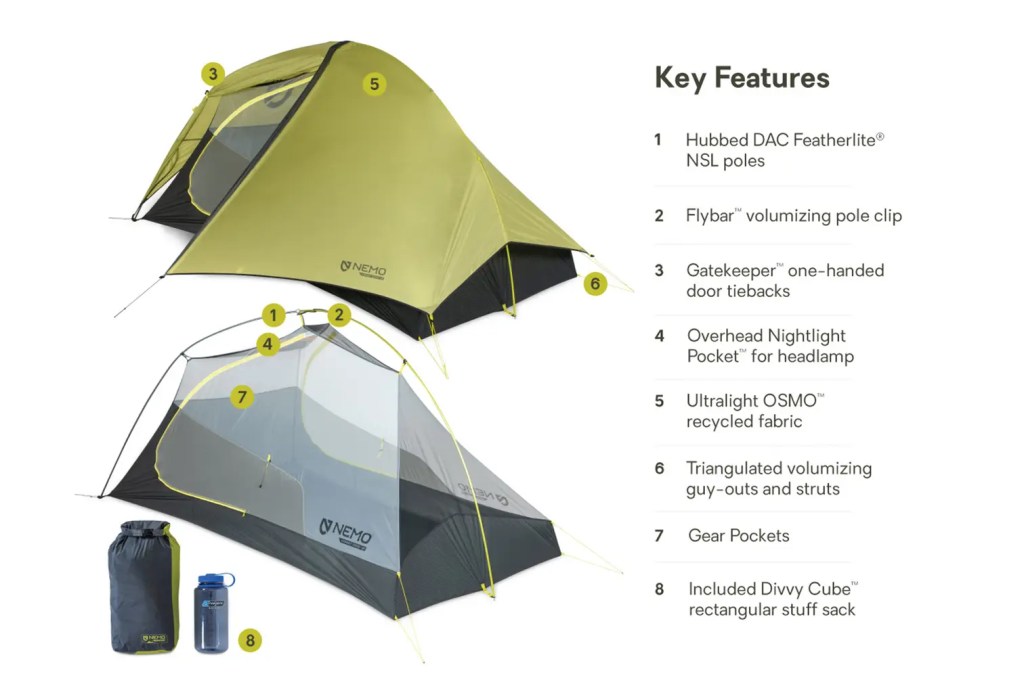
So far it has never disappointed me and with the new Osmo series the material seems to be even more durable. As a shelter it is not too heavy and still enables me to put my backpack inside and move without becoming claustrophobic.
If you are not travelling alone, obviously the 3P tent should be your choice and again, that applies to all ultralight tents.
Other typical brands that you will find are MSR and Big Agnes. Some people prefer Duston, which you set up with your hiking poles but condensation is quite a bit of a problem.
Let’s jump to my four poster bed. -Just kidding-
We are used to sleep in a house in our bed off the ground and surrounded by walls that keep away cold and rain, condensation and wind. In a tent having a sleeping system (sleeping pad and sleeping bag) that is cheap and gives you the shivers at night is the worst thing you can have. Hypothermia can kill you. and having a bad nights sleep might as well, especially if the trail is difficult because sleep deprivation can make you inattentive and prone to accidents.
Key to enough warmth sleeping on the ground is a sleeping pad that has a high r-value. Which means the higher the better it protects you from the cold coming up from the ground.
The three most often mentioned companies by thru hikers seem to be nemo (US), therma-rest (Ireland) and Sea to Summit (Australia). I own one from all three and I like all of them but for this trip I will take the nemo tensor as it has the highest r-value vs weight. The version I have is no longer available but there seems to be a new one coming out.
And finally the sleeping bag.
This is a bit of a religion: down or synthetic fibres, that is the question. I decided on down and have not regretted it. It is light and warm and despite the myth that it dries very slowly, most down sleeping bags need ages to actually become soaking wet. I invested quite a bit as I own three different ones depending on the temperatures that I might encounter.
Unfortunately my version of the Sea to Summit Flame sleeping bag is no longer being sold but they have a new version called Spark.
The world of hiking equipment is in constant change and the companies I am mentioning here are just a starting point for your own journey. Obviously there is much more to say about a few niche companies but it’s not the focus of what I want to share. If you have questions or want to know more leave a comment.
And make sure you hike your own hike!
 One Year - Five Continents